
Colored Soup Cans: Choosing Commercially Primed Canvas
While investigating how Andy Warhol prepared the canvases for his 1965 Colored Campbell's Soup Cans, we experimented with different paints, primers, and fabric surfaces.
Our Benjamin Moore acrylic house-paint tests produced relatively flexible surfaces, while the KILZ alkyd-coated samples became noticeably stiffer after drying.
But as we continued examining historical photographs of the Factory, something caught our attention that made us reconsider our approach.
What if the canvases Warhol and his assistants were working with had already been primed before they arrived at the Factory?
Several photographs from the 1960s offered some intriguing clues.

A Clue in a Factory Photograph
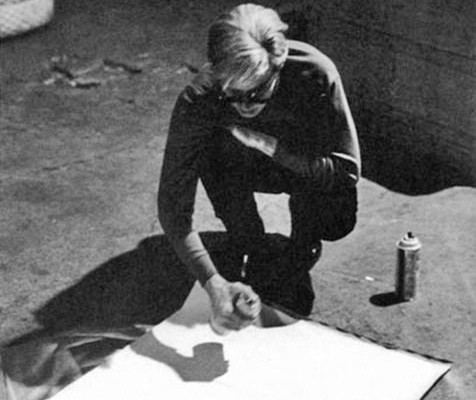
One photograph in particular caught our attention. Taken by Nat Finkelstein, it shows a large sheet of white canvas unrolled across the Factory floor, with a Campbell's Soup Can image being worked on near its edge. A motorcycle stands in the background.
At first, we were looking at the familiar soup-can imagery. But then we noticed the large roll of canvas itself.
The exposed surface appeared remarkably white and even. The material was neatly wound, and the loose sheet extended across the floor without appearing excessively rigid.
Was the Factory applying its own initial white preparation, or was the material arriving from an art supplier with that preparation already completed?
Instead of beginning with raw cotton canvas and attempting to reproduce an original priming operation, we might need to start with commercially prepared artist's canvas.

Another Clue in Stephen Shore's Photographs
As we continued examining Factory photographs, we came across another interesting image taken by Stephen Shore between 1965 and 1967. The studio floor is covered with works in progress, painting materials, and loose canvases. Several of the canvases have already received painted colors, while their white surrounding margins remain visible.
What caught our attention was the way the fabric was spread across the floor, with some sections folded or curling back on themselves. The photograph offered another glimpse into how canvases were handled during production, before being mounted onto stretcher frames.
Because these canvases had already undergone painting, their white surfaces cannot tell us how the original fabric was primed. However, the photograph provides useful evidence of the Factory's working environment and the way loose canvases were handled during different stages of production.

Examining the Canvas Edges
Looking more closely at the Factory photographs, we became particularly interested in the transition between the white prepared surfaces and the exposed edges of the canvas.
In photographs showing Campbell's Soup Can paintings being handled and trimmed, the surrounding white fields appear relatively uniform, while some edges reveal darker fabric and irregular, frayed fibers. These details interested us because commercially primed canvas can have a similar appearance.
However, a white surface in a historical photograph doesn't necessarily reveal how it was prepared. A commercially applied primer, an additional painted ground, or a sprayed coating can produce similar visual characteristics.
These observations encouraged us to examine modern commercially prepared canvas more closely, particularly the relationship between its primed face, fabric reverse, and cut edges.
Choosing Commercially Primed Canvas
With these observations in mind, our research into Andy Warhol and commercially primed canvas led us to search for a suitable material that could serve as a practical starting point for our reconstruction. We selected Utrecht Studio Acrylic-Primed Cotton Canvas, purchased from BLICK Art Materials. The material is supplied in rolls with a prepared white painting surface.
Rather than beginning with raw fabric and attempting to reproduce the original priming process, we wanted to examine how commercially prepared canvas compared with what we'd observed in the historical Factory photographs. When the material arrived, we unrolled it and began documenting its physical characteristics.
The white prepared face was relatively even, with the underlying canvas weave still visible. The reverse retained the darker, natural color of the cotton, and the exposed edges showed frayed fibers. The material could also be rolled and handled without becoming excessively rigid. These similarities were interesting, although our modern canvas cannot establish exactly what Warhol used in 1965.

Comparing the Prepared Surface and Fabric Reverse
One of the most useful observations came from examining the canvas close-up. Where the material was folded back, the contrast between the commercially prepared white surface and the natural cotton reverse became particularly clear.
The primed face was relatively white and uniform, while the reverse retained the natural color and texture of the cotton. Along the cut edge, exposed and frayed fibers revealed the transition between the two surfaces.

This was the physical distinction we'd been looking for in the historical photographs. The canvas had a continuous white prepared surface, yet remained flexible enough to roll, bend, and cut.
Although the comparison cannot establish the materials Warhol used, it helped explain why commercially primed canvas was a practical starting point for our reconstruction.
Preparing the Canvas for Further Experiments
Choosing commercially primed canvas didn't necessarily mean that Warhol and his assistants avoided applying additional white paint. Our investigation into the 1965 Colored Campbell's Soup Cans has raised separate questions about painted grounds, sprayed coatings, and the sequence of subsequent color applications.
To explore this possibility, we tested Krylon Classic Gloss White aerosol paint over our commercially acrylic-primed canvas. We wanted to see how an additional sprayed layer affected the white surface, particularly its coverage, visible fabric weave, texture, and how light reflected from the coating. The Krylon paint was a modern experimental material, not an identification of what Warhol originally used.
The experiments helped us distinguish between the canvas's original commercial preparation and any additional white coatings that might have been applied during production. Understanding these separate stages will be important as we move toward reconstructing the painting and silkscreen printing sequences.


Following the Evidence
Our experiments with Benjamin Moore acrylic paint and alkyd primer helped us understand how different coatings affect canvas. But it was the historical Factory photographs that encouraged us to reconsider whether the original fabric might have arrived already prepared.
Examining those photographs alongside modern commercially primed cotton canvas gave us a practical starting point for the reconstruction. The white surfaces, exposed fabric edges, and flexibility of the material were particularly useful comparisons, although the historical photographs cannot establish the original primer's composition or where it was applied.
We've decided to use commercially acrylic-primed canvas as the starting material for our reconstruction of the 1965 Colored Campbell's Soup Cans.
This is a working decision, not a claim that we've identified Warhol's exact materials. We still have questions about the original canvas specifications and any additional painted or sprayed grounds applied during production.
For now, we've established a direction for the next stage of our experiments, and we'll continue sharing what we discover along the way.
Related Research
Andy Warhol's Factory: Exploring Benjamin Moore Regal Wall Satin — Identifying a historical paint container and testing modern acrylic house paint.
Warhol's Canvas Preparation: Exploring Historical Alkyd Paints — Investigating historical alkyd materials and conservation evidence.
Andy Warhol's Canvas Preparation: Alkyd vs. Acrylic Paint — Comparing modern coatings and canvas flexibility.
Andy Warhol's 1965 Colored Campbell's Soup Cans: Reconstructing the Factory — The broader investigation into the paintings and their production.
Explore the Research


Comments